
Original editorial cover illustration — Southlake Vision. Product imagery is illustrative.
Create an information hierarchy for the furniture
Amazon furniture photography in China needs to distinguish appearance from assembly and operation. A finished room scene can show where a piece belongs, but it does not explain which parts arrive, how a joint connects or how much space a moving section requires. List the questions separately and choose the image method that answers each one most clearly.
For a hypothetical side table with a drawer, establish three layers: the assembled product, the verified construction or dimensions, and normal drawer operation. This is a planning example rather than a claim about a client project. Southlake Vision can coordinate photography and graphics from that hierarchy. The aim is a coherent explanation, not an overloaded image that attempts to show the finished product, every part and a complete installation manual simultaneously.
Make the sale configuration unambiguous
Start with the assembled reference and confirm that every visible component belongs to the sold configuration. Check feet, handles, panels, cushions and supplied accessories against the approved list. If the furniture arrives partly assembled, record that state separately from the fully assembled appearance. Distinguish the finished item from props such as a lamp or storage basket.
Then identify any configuration options that need their own assets. A different drawer front, reversible orientation or additional shelf may change more than the product name. Review home product examples to discuss relevant viewpoints without treating the mixed category as a single documented furniture project. The actual sample, component record and verified specification determine what the new gallery may accurately show.
Show installation evidence without inventing an assembly manual
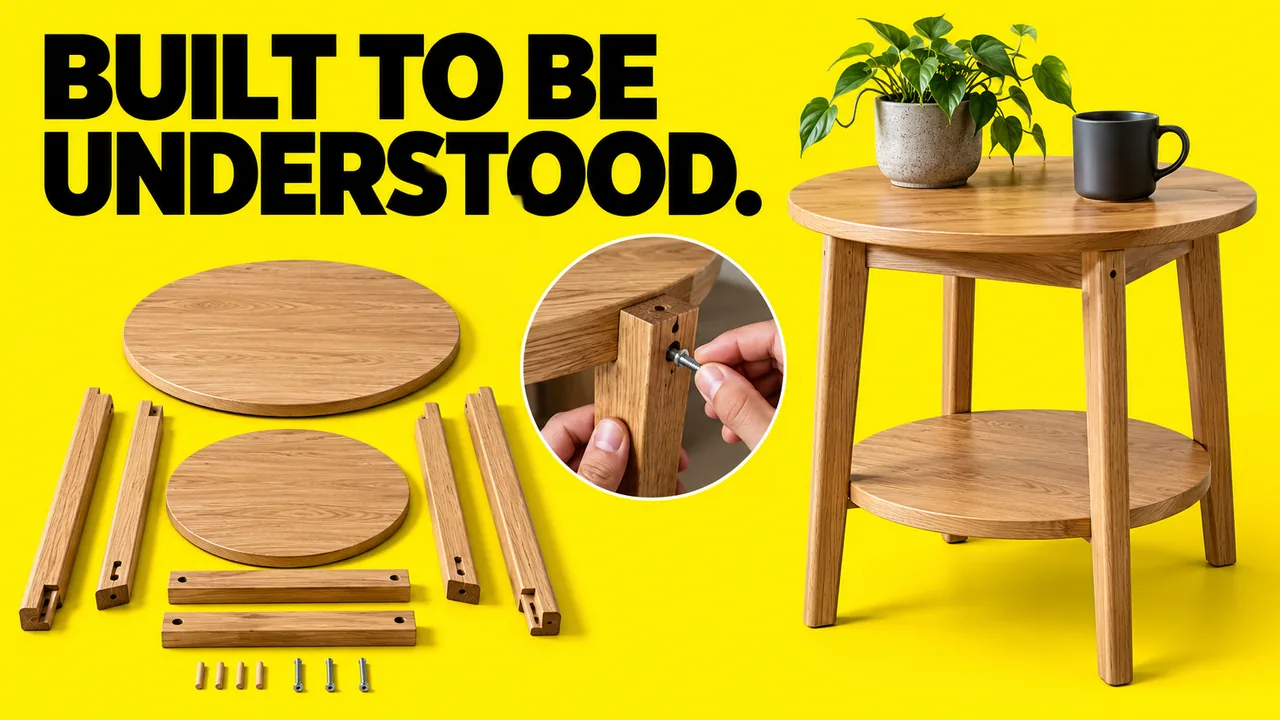
Choose installation details that resolve genuine uncertainty. A photograph of the actual connector and correct fastening direction may be useful, whereas a decorative exploded arrangement may not explain the sequence at all. Supply the manufacturer's approved instructions and name a technical reviewer. The photography team should not reverse engineer an assembly method and present it as authoritative guidance.
If a component arrangement is commissioned, label the real parts and count them carefully. Do not include substitute hardware simply because it photographs more clearly. Decide whether tools are included and communicate that accurately. Where assembly requires multiple stages, discuss whether a simple diagram, selected detail images or a dedicated sequence is appropriate. A marketing gallery should not imply that a small set of attractive photographs replaces the complete supplied instructions. During review, place the proposed installation image beside the relevant instruction step. Check the part identity, orientation and visible connection. If the picture omits a necessary intermediate action, describe its limited explanatory role instead of presenting it as a complete sequence.
Define exactly what each measurement describes
Furniture dimensions are easy to mislabel. Overall width, usable shelf width, internal drawer depth and clearance beneath a frame describe different things. Obtain approved measurements and mark the reference points on a product record before design begins. If the furniture has soft cushions, identify whether the value refers to the frame, the cushion or another agreed condition.
Ask the Amazon design service to place arrows against those named points rather than improvising endpoints from the photograph. Check units and variant differences. A dimension label should not appear precise while pointing to an ambiguous surface. Keep the measurement source with the artwork so a later size update can be traced to the affected graphic instead of being copied into a template from memory. Give a reviewer the unlabelled source and ask them to identify the intended endpoints before showing the finished arrows. A disagreement at this stage exposes ambiguity that polished typography would otherwise conceal.
Map moving parts as states with visible relationships
A drawer, hinged panel or extending surface needs a state map. Identify the closed position, the useful open position and the detail that explains the mechanism. Decide what each photograph contributes. A wide open drawer may show interior storage, while a close view of the runner addresses construction. Neither automatically proves a load rating or a safety characteristic.
For the hypothetical side table, compare the closed reference with an open view that preserves the same product identity. Avoid angles that hide the travel path or make an extension look longer than it is. If the movement itself is the important explanation, consult product video production. A still library can describe selected states, but it cannot always communicate the complete transition between them.
Keep claims separate from staged demonstrations
A person leaning on furniture or a drawer filled with heavy objects can imply performance. Do not stage those scenes without confirmed product information and an appropriate plan. Visible operation should follow the intended use, with the approved sample assembled correctly. A scene is not a substitute for testing, and the studio should not create unsupported strength, durability or safety claims through styling.
Use copy that names observable features or verified specifications. Match each moving-part photograph with the correct assembled configuration and the manufacturer’s explanation of normal use. Confirm current category and marketplace requirements before final delivery, then inspect the final assets for consistent terminology, legible labels and correct measurement references. This gives the publishing team a clear connection between each image, its approved source facts and the product actually offered.
Proof the gallery as a connected explanation
Lay the proposed images out in order and ask whether the reader can follow them without prior product knowledge. The assembled reference should identify the piece, dimensions should resolve fit questions, installation details should clarify selected connections and operation images should reveal useful states. Remove repeated angles that contribute no new information while leaving a more important question unanswered.
Inspect the listing image portfolio for ways to discuss visual hierarchy and readable graphics, then approve the new work against your own facts. Check that an open configuration still matches the closed image, that handle positions remain consistent and that no retouching has hidden a joint. Review small text at the actual display size before approving the finished design.
Deliver source facts with the final image set
A practical handover links each image to the product code, sample configuration, measurement version and approval status. Keep assembly detail files separate from any complete instructions supplied by the manufacturer. Identify which photos support several variants and which must remain specific. If a component changes, this record reveals which pictures and graphics require reconsideration.
Send Southlake Vision your furniture instructions, dimensions and moving part reference photographs when requesting a scope. Include the exact sale configuration and the buyer questions you need the gallery to answer. Use the production process to assign factual approval before design export. A specialist furniture library makes assembly, fit and function understandable while respecting the limits of what photography can honestly establish.
Frequently asked questions
Can a photographed parts arrangement replace assembly instructions?
Not automatically. A component view can clarify what is supplied but may not explain safe sequencing or fastening. Use the approved manufacturer instructions and technical review when planning installation imagery. Define the marketing image’s limited purpose clearly.
What measurement errors should reviewers look for first?
Check that arrows identify the correct surfaces and distinguish overall, internal and clearance dimensions. Verify units, variant identity and the specification version. A correct number attached to the wrong reference points can still mislead.
When should moving furniture be filmed instead of photographed?
Use motion when the transition or handling is difficult to understand from selected states. Plan the action and camera coverage separately. Clean still views remain useful for dimensions and construction even when a demonstration video is included.