
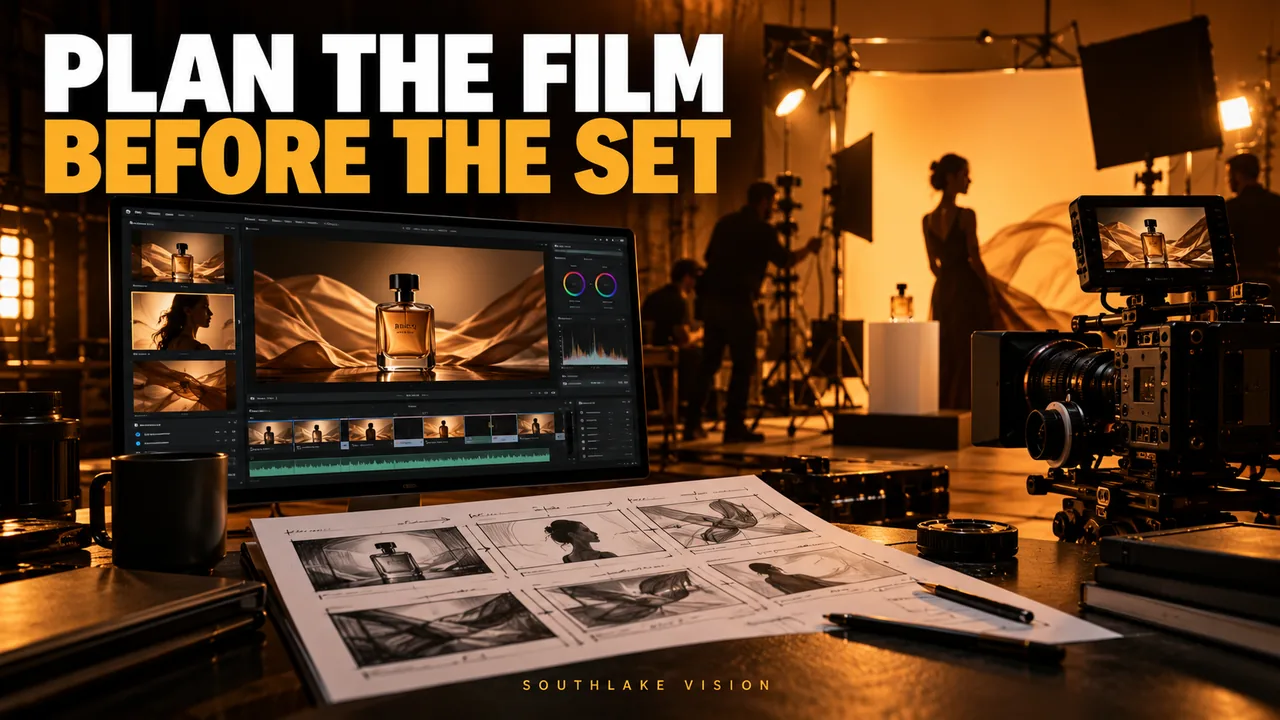
Original editorial cover illustration — Southlake Vision. Product imagery is illustrative.
Start with one decision the viewer needs to make
Product video production services become easier to brief when the objective describes a customer decision. A shopper may need to understand how a folding product opens, see whether a finish suits their room, or compare two supplied accessories. These are different communication tasks. “Make it premium” gives a mood, but it does not explain which information belongs in the film.
Write a single sentence beginning “After watching, the viewer should understand…” and complete it with a specific product truth. Then identify the intended destination and audience. A product page film may explain a mechanism patiently, while an advertising edit may introduce the same mechanism much earlier. Neither version should depend on claims that the brand cannot substantiate or functions that the supplied sample cannot perform.
Translate the story into coverage
A storyboard does not need elaborate illustrations to be useful. A table with shot number, visible action, framing, message, and proposed text can expose gaps before a camera is booked. For a hypothetical countertop dispenser, the sequence might include the complete product, filling, pressing, dispensing, cleaning, and the included components. Treat this as an example brief, rather than a mandatory structure for every product.
Coverage is the material needed to build that sequence: a wide view that explains position, a closer view of the action, a detail of the mechanism, and a clean ending. Request alternatives where they serve a real editing need. Recording five nearly identical beauty angles cannot replace the one operational view that makes the product understandable.
Separate the master film from adaptation work
A master edit and a shorter adaptation are related deliverables, but they are not identical exports. An adaptation may need a new opening, different text pacing, alternative music timing, and a revised closing message. Changing from a horizontal frame to a vertical frame may also require repositioning the product or selecting separately recorded coverage. Define these choices in the quotation.
Create a delivery matrix containing each version’s purpose, approximate duration, orientation, language, subtitles, and audio treatment. A brand could request a horizontal explanation and a vertical teaser, for example, without assuming those dimensions are universal platform requirements. The team should verify the requirements of the actual destinations before editing. Southlake Vision’s video services can be discussed around this matrix rather than an ambiguous number of videos.
Approve the sample and the physical action
Moving images make sample defects and awkward operation especially visible. Check the correct model, color, accessories, labels, and packaging before filming. If a lid sticks or an assembly does not align, flag the problem instead of asking the editor to conceal it. A replacement sample or revised demonstration may be necessary, and either can affect the schedule.
Document how the product should be used, which actions require trained handling, and what must stay outside the frame. Supply instructions and brand approved terminology. For mechanisms, ask the production team to rehearse the action before final lighting is set. The acceptance criterion should be an accurate, repeatable demonstration of the intended function, not merely a visually smooth movement that misrepresents the product.
Plan lighting for movement and material
Lighting a still image and lighting a moving action involve different compromises. A reflection controlled for one camera angle may slide across a glossy surface when the camera moves. A hand entering the frame can obscure the label or cast a shadow over the mechanism. Test the full action, rather than approving only a frozen opening frame.
A useful material test includes the widest movement, the closest detail, and any major color change in the set. Soft illumination can keep packaging readable, while a narrower highlight may explain a metal edge more convincingly. The right balance depends on the product. Where stills are also needed, align the visual direction with product photography, but allow time for separate lighting adjustments.
Make audio and text explicit production decisions
Decide whether the film needs location sound, music, voiceover, subtitles, or a combination. A quiet demonstration of a closing mechanism may benefit from its actual sound; a decorative tabletop sequence may not. Voiceover introduces script approval, pronunciation checks, performance choices, and possible rerecording. These should be scoped before recording begins.
Keep text concise enough to read during the planned shot. Instead of placing several benefits over one fleeting closeup, assign one message to the relevant action. Supply confirmed specifications and spelling in a shared text document. Ask for an early check of typography against bright and dark scenes. Music licensing and any voice talent usage terms should be specified for the channels, territories, and period required.
Use review milestones with clear acceptance criteria
Begin with approval of the brief and storyboard, then review the proposed visual treatment, followed by the first edit. Feedback should refer to shot numbers or timecodes and distinguish factual errors from creative preferences. “At 00:18, the included brush is missing” is actionable; “it does not feel right” needs a more concrete explanation.
Agree what constitutes completion: correct product version, approved sequence, legible text, appropriate audio balance, accurate color, and the promised file versions. Confirm the review allowance and how additional filming or a changed brief would be handled. Southlake Vision typically discusses first drafts around seven to ten working days after samples and the brief are confirmed, with the actual timetable dependent on the project scope.
Build a handover that remains usable
Final delivery should identify which file belongs where. Use version names that distinguish the master, language, orientation, and approved revision, then keep an export manifest alongside the files. Confirm whether source footage, project files, alternate takes, or thumbnail stills are included; their inclusion should never be assumed from the phrase “video production.”
Retain the approved script and product facts with the delivered assets so future editors understand what was agreed. Explore the Southlake Vision homepage for connected photography, design, and video capabilities, then send the delivery matrix through the contact page. A precise request makes it easier to compare proposals and avoid paying for versions that do not support a defined marketing use.
Frequently asked questions
Can one shoot produce advertising and product page videos?
Often, provided both purposes are included in the coverage plan. Different openings, framing, pacing, and closing messages may be required. Confirm the versions before filming, since footage designed for a slow horizontal explanation may not contain the close framing needed for a short vertical advertisement.
Should raw footage be included in the quote?
Ask for it explicitly if your internal team expects to edit later. Confirm selection, file formats, transfer arrangements, usage, and whether any third party elements are excluded. A finished film quotation does not automatically include every recording or the production project files.
What is the most useful first document to send?
Send a short objective, the exact sample list, priority functions, intended channels, reference films with comments, and a delivery matrix. Include approved claims and a realistic launch date. This lets the production team identify missing coverage and scope the work before proposing a schedule.