
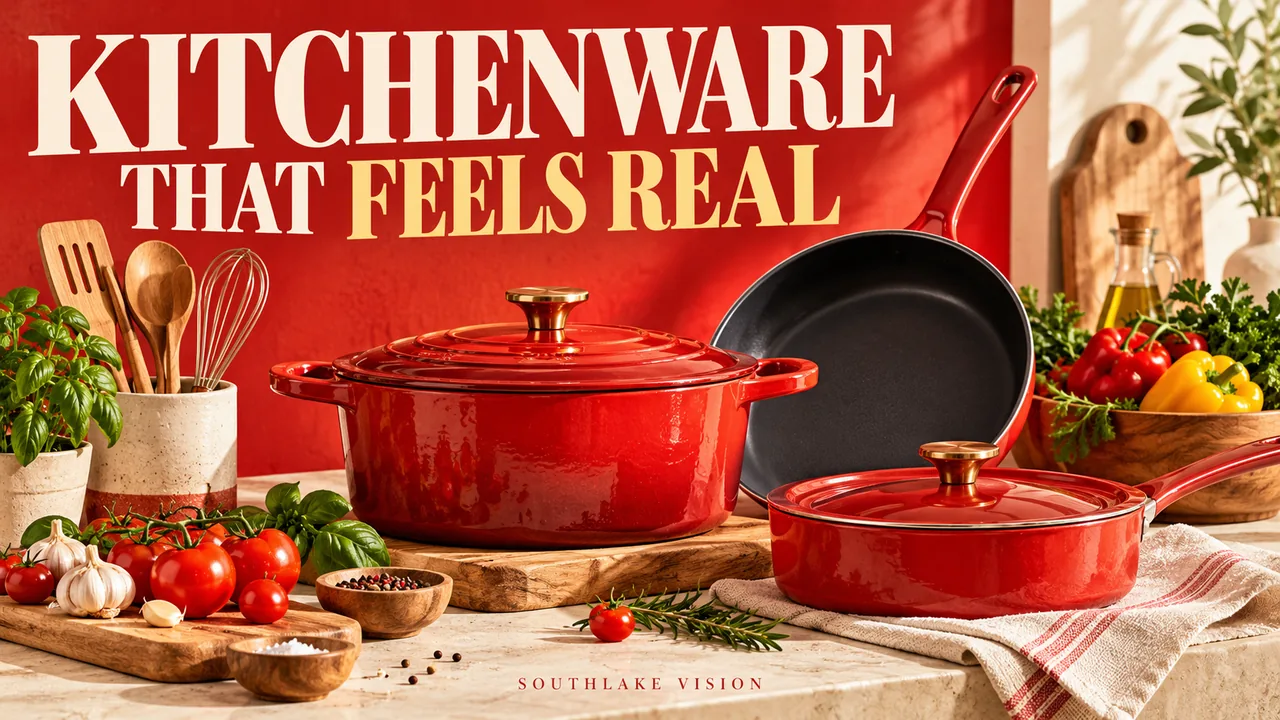
Original editorial cover illustration — Southlake Vision. Product imagery is illustrative.
Give each kitchenware image a clear role
Kitchenware product photography needs to balance an appealing meal with an understandable product. The food should support the utensil, vessel, or appliance rather than conceal it. Begin by separating catalogue views, functional demonstrations, material details, and atmosphere. A pan photographed for its handle shape requires a different composition from the same pan presented as part of a family table.
List what the buyer must verify: overall form, included pieces, lid fit, interior finish, handle connection, and normal use. Not every product needs every image type. Assign a purpose to each frame so a gallery does not become several beautiful views that repeat the same information. The most useful sequence moves from identification to detail and then to realistic context.
Prepare the correct sample and complete set
Confirm the exact saleable configuration before food or props arrive. A product sold as a single utensil should not be photographed with matching accessories in a way that implies they are included. For sets, create a component inventory and mark which pieces appear in the main product view. Keep packaging and approved specification sheets available for reference.
Check for transport scratches, fingerprints, loose handles, labels, and protective films. Decide which marks are temporary sample issues and which represent the actual finish. Do not retouch away meaningful construction characteristics to create an unrealistic product. If the item is a prototype or differs from the approved retail version, resolve that difference before committing to a complete library of images.
Style food to reveal the product
Choose food with the product’s function and color in mind. A dark dish may disappear against a black interior, while a sauce covering the rim can hide the vessel’s profile. Use an appropriate portion and arrange it so the important edges, handles, or working surfaces remain visible. A generous looking meal should not mislead viewers about capacity.
Prepare a food plan with ingredients, quantities, resets, and the order of scenes. Freshness changes quickly, so photograph clean catalogue views before messy cooking actions when practical. For a hypothetical chopping board, one scene might show a few chopped vegetables beside an exposed cutting surface, followed by a closer view of the edge and grip. This is an illustrative brief, not a prescribed shot count.
Control metal, glass, and dark finishes separately
Kitchenware often combines materials that respond differently to light. A polished lid reflects the room, a matte handle absorbs detail, and a glass section may become invisible against the background. One lighting arrangement may not show all three clearly. Ask for a test frame that reveals the hardest combination before approving the full setup.
Broad light can create a clean sweep across metal, while controlled dark reflections explain its curvature. Slight changes in product angle may make a rim readable without adding a distracting highlight. Compare the sample with the image and preserve the actual finish. Southlake Vision product photography can be scoped around these material challenges, alongside the intended catalogue or lifestyle treatment.
Show operation with credible hands and scale
A hand can explain grip, pouring, or opening more efficiently than an isolated detail. Plan the action with the actual user instructions and choose an angle that keeps the mechanism visible. Avoid poses that look elegant but would be uncomfortable or unsafe in ordinary use. Hot items, sharp tools, and powered appliances require appropriate preparation and handling.
Scale should come from truthful relationships: a normal place setting, a suitable ingredient, or the user’s hand in a natural position. If dimensions are shown graphically, use approved measurements rather than estimating them from perspective. Review the kitchenware case category and the cutting board project as visual starting points, then explain which specific product questions your new photographs need to answer.
Keep the set believable and commercially useful
A kitchen scene should suggest a coherent use environment. Choose a limited palette, compatible surfaces, and props that match the product’s positioning. Too many ingredients, decorative utensils, and textiles can make the image feel busy and obscure the item. Check the frame in a small thumbnail, because clutter becomes more obvious when the product occupies less space.
Build alternate compositions for the agreed uses instead of placing all important details at the edge. A wide website banner may need negative space, while a catalogue tile needs stronger product presence. Confirm each destination’s requirements before shooting. Do not treat the crop as an afterthought, particularly when tall handles, pouring streams, or a complete table setting determine the shape of the composition.
Plan cleaning, resets, and consistent color
Food production has a practical rhythm. Oils, flour, condensation, and fingerprints change the sample between shots. Identify who prepares, cleans, and resets the product, and whether duplicate samples are needed for the scope. Record the clean reference state so the team can restore the correct appearance after a cooking demonstration.
Keep color references and styling records for repeat orders. If the collection includes several finishes, review them together rather than approving each on a different display setting. The goal is a consistent library that still preserves genuine differences between finishes. Arrange approvals through the production process, including a named reviewer for the actual product details and a separate decision on optional styling preferences.
Approve a library that answers buying questions
A practical review checks more than appetite appeal. Verify the complete set, readable contours, accurate finish, realistic portions, natural handling, and the absence of distracting reflections. Confirm that the photographs do not imply an accessory, food ingredient, or capacity that is not part of the offer. Compare the final crops as a group to spot repetition or missing information.
Explore the Southlake Vision homepage for connected photography, listing design, and video production, and send the inventory, food direction, usage requirements, and sample plan through the contact page. A precise kitchenware brief gives the team room for attractive styling while protecting the facts the buyer needs to evaluate the product confidently.
Frequently asked questions
Should we photograph food in every kitchenware image?
No. Clean product views establish shape, finish, and set contents without distractions. Food can then explain scale or everyday use in selected scenes. Choose ingredients deliberately and keep important surfaces visible rather than using decoration simply to fill an empty part of the frame.
How many samples should we send?
The number depends on food handling, cleaning, destructive actions, and the quantity of scenes. Discuss duplicates when one sample may become stained or unavailable during resets. Label variants and confirm the saleable set. The studio should agree a sample requirement after reviewing the actual brief.
Can one shoot include cooking video?
It can, when planned in advance. Video may require repeated actions, different lighting, additional food, and separate framing. Include the desired sequences in the quote so still photography does not consume ingredients or alter the product before essential moving shots have been recorded.