
Editorial cover illustration — Southlake Vision.
Identify what you want an external team to own
To outsource product photography effectively, decide which responsibilities will move outside your business. Capture, styling, retouching, graphic design and project coordination are related but separate tasks. Your brand still needs to approve the product information and intended positioning. Start with an asset list and a responsibility map. The Southlake Vision homepage provides an overview of services that can be combined or scoped individually around your production needs.
Compare complete deliverables instead of headline rates
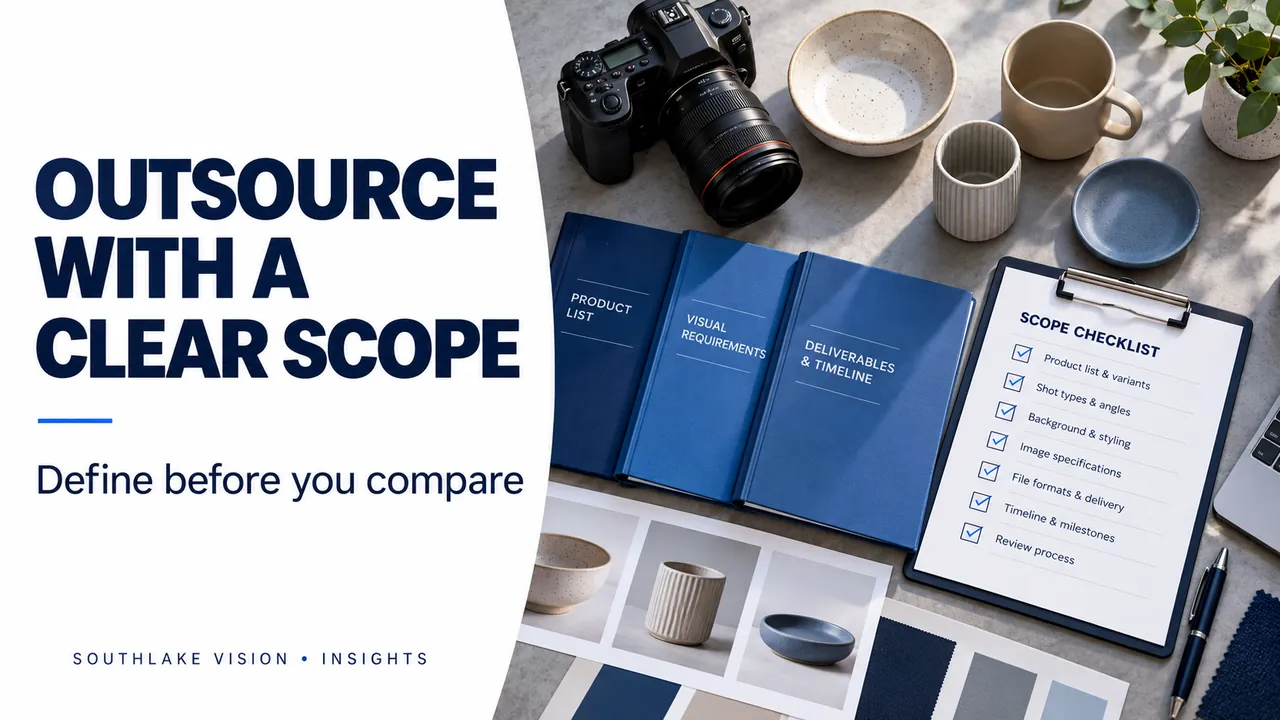
For outsourced ecommerce photography, a price per image has limited meaning without a description of the work behind it. Specify product count, variants, angles, backgrounds, preparation and retouching level. State whether the output includes only photographs or also copy, designed graphics and additional crops. Identify models, props and set construction separately. A complete scope makes quotations easier to compare and helps prevent a change request from being mistaken for an included deliverable.
Calculate coordination and revision effort
Include the time your team will spend collecting specifications, approving references and reviewing drafts. A cheaper quote can become difficult to manage if the handover is unclear or feedback is scattered across several contacts. Ask how the studio handles revisions, extra shots and replacement samples. Establish one feedback owner. For repeating work, record an approved lighting and crop system so each new batch starts from a usable standard rather than a fresh interpretation of the brand.
Assess outsourcing to China against your supply chain
Product photography outsourcing to China can be suitable when samples are already with a Chinese supplier. Evaluate the actual transport route, production requirements and approval process. Do not assume a fixed cost saving or turnaround advantage. If the brief requires a specific location, model profile or specialist demonstration, check that separately. Compare the total route from sample readiness to final files, including the practical effort of obtaining missing accessories or correcting a sample version.
Agree on rights, files and continuity
Clarify the licensed channels, territories and duration where applicable, along with model and third-party asset usage. Confirm whether high-resolution masters, transparent files, raw captures or editable layouts are included. Keep your SKU naming system consistent. If the project also needs Amazon design or product video production, assign those outputs their own approval steps. Shared production should improve coordination without making the handover ambiguous.
Test the relationship with representative work
A small first batch can test material handling, communication and final file organisation. Choose products that represent the challenges of the wider catalogue. Review against the approved scope and document the changes needed for repeat work. Use the production process to discuss how your internal team and the studio will work together. Request a scoped proposal with the product list, reference direction and delivery requirements rather than asking for a generic outsourcing rate.
Frequently asked questions
Should I outsource the entire visual production process?
Only if it suits your team. You can keep strategy and copy approval in-house while commissioning photography, design or editing as defined outputs.
What makes a pilot batch useful?
It should include representative materials, at least one typical variant issue and the delivery formats your team will actually use. Evaluate process and accuracy alongside appearance.