
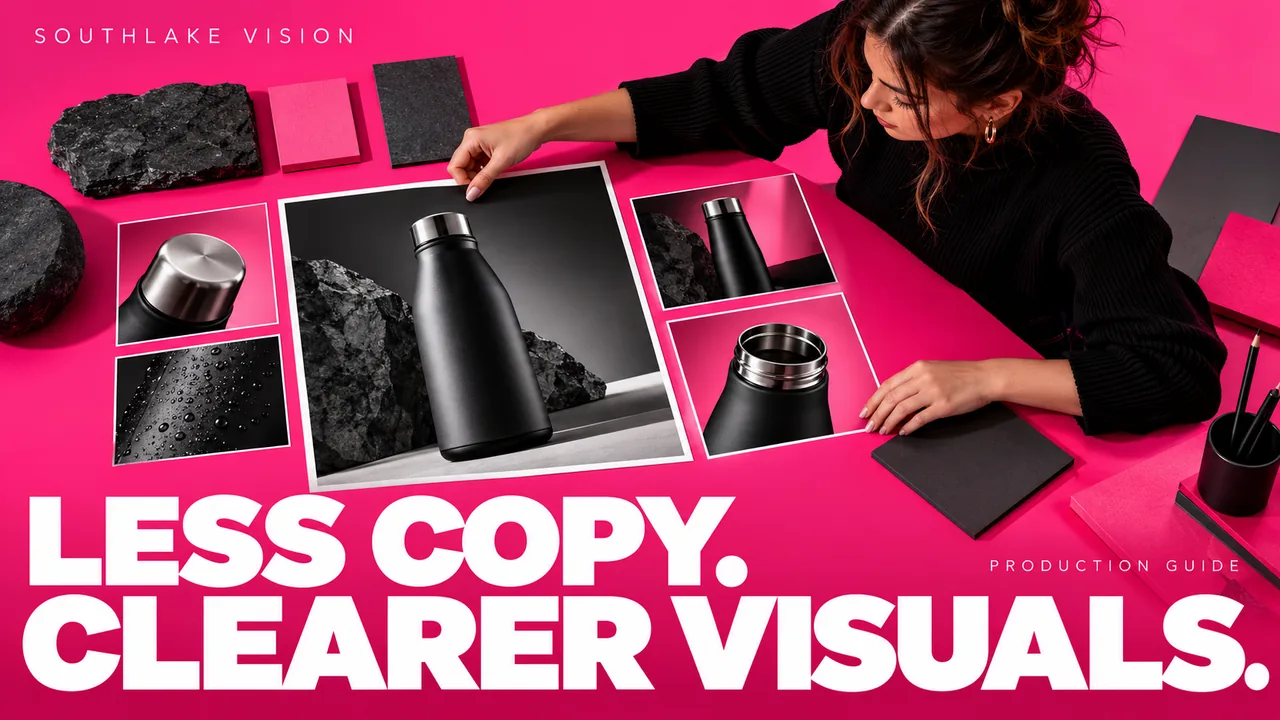
Original editorial cover illustration — Southlake Vision. Product imagery is illustrative.
Write the message before decorating the frame
Amazon listing image design is partly an editing exercise. The designer must decide which message deserves attention and which words can disappear because the photograph already explains them. Begin with a short sentence describing what the customer should understand after viewing the image. This sentence is an internal objective, not necessarily the final headline.
For a hypothetical stackable container, the objective might be that the lid supports stable stacking when used in the intended configuration. The final visual should show that relationship clearly, while a short headline identifies the relevant benefit. Southlake Vision can coordinate the photograph and layout around this shared purpose. Writing the objective first prevents attractive typography from becoming disconnected from the actual product evidence.
Build a claim sheet that separates fact and interpretation
Before writing headlines, gather verified facts from the product owner. Include dimensions, materials, compatible components, included pieces and approved care instructions. For every claim, record the source and the person responsible for confirmation. Mark language that requires specialist or marketplace review rather than treating it as ordinary promotional copy.
A factual statement such as a verified compartment count is different from an interpretation such as easier organisation. Both may be useful, but they require different support. Avoid turning a modest feature into an absolute promise. Words like perfect, guaranteed or indestructible create expectations the image cannot substantiate. Good copy gives the customer a specific reason to inspect the product, with wording proportionate to what is actually known.
Match each headline to something visible
A headline should direct attention toward evidence already present in the image. If the copy discusses a lid seal, the photograph needs to show the closure clearly enough to make the message understandable. If the text focuses on softness, a distant room scene may provide insufficient material detail. Change the image or narrow the message until they support one another.
Create a copy and photography pairing sheet before the shoot. Each row should contain the proposed headline, the detail that proves it and the necessary camera view. This allows Amazon creative production to capture intentional negative space and useful close views. Otherwise the design team may be forced to place text over a busy image or explain a feature that was never photographed.
Use a hierarchy that survives reduction
A useful image usually has one dominant text level, supported by a small amount of secondary information where necessary. The headline establishes the topic; a short supporting line explains a relevant condition or detail. Tiny paragraphs and numerous equal sized labels make the viewer work too hard, particularly when the image appears on a phone.
Test the design at a reduced size throughout development. Ask someone unfamiliar with the brief to identify the message after a brief glance. If they read the decorative phrase but miss the product or its evidence, rebalance the layout. Large type is not automatically clear: line breaks, contrast, placement and the amount of surrounding content all affect comprehension. Keep essential words within a stable, uncluttered part of the composition.
Replace generic praise with product specific language
Generic statements such as premium quality or upgrade your life rarely explain why this particular item matters. They can also be repeated across almost any product category. Replace them with a concrete observation that the image can support: a removable divider, a visible fastening method or a handle designed for a defined grip position.
This does not mean every headline must sound technical. Brand tone can remain warm, direct or sophisticated while the information stays specific. A hypothetical bedding image might focus on the visible woven texture rather than claiming an undefined luxury experience. Review related textile work when discussing the relationship between material photography and copy. The strongest phrase is often the one that names exactly what the customer is looking at.
Edit English for international comprehension
Many international customers read English as an additional language. Prefer familiar verbs, concrete nouns and short constructions. Avoid puns, culturally narrow expressions and compressed slogans that require interpretation. An apparently clever headline can become a barrier if the buyer cannot connect it to the image quickly. Check spelling style and terminology across the entire set.
Product terms should also remain consistent. If one frame calls a component a tray and another calls it a base, confirm whether these are the same part. Establish a small glossary before copy approval. When several regional versions are planned, keep editable text separate from flattened artwork and document the approved terminology. This makes later adaptation more reliable than attempting to translate text embedded inside a finished photograph.
Review claims and platform suitability separately
Run two distinct checks before final approval. The factual check confirms that the words accurately describe the supplied product. The platform check confirms that the intended placement and content follow current Seller Central requirements for that marketplace and category. A statement can be factually correct and still be unsuitable for a particular image placement.
Do not apply supporting image treatments to the main image without verifying its applicable rules. Keep the scope clear about which frames include designed text and which remain product photography. A review log should identify each image, the approved copy and any restrictions. The production workflow can establish a single copy approver so that design does not cycle through conflicting preferences from several reviewers.
Preserve the copy system after delivery
Deliver the approved copy alongside the visual files in a simple document or spreadsheet. Include the final headline, supporting text, claim source and product version for each image. This record becomes valuable when a manufacturer changes a component or a new variant uses different dimensions. The team can then identify which statements remain valid and which require revision.
When refreshing a gallery, evaluate whether an existing image lacks evidence or merely uses too many words. Sometimes a tighter crop and a shorter headline solve the problem; sometimes a new photograph is necessary. The objective is not minimal text at any cost. It is a balanced relationship in which the photo shows, the copy guides attention and the customer can understand both without unnecessary effort.
Frequently asked questions
How short should an image headline be?
There is no universal word limit. Keep the headline short enough to read at the intended display size and specific enough to identify one message. Test it with the actual layout rather than approving copy in a document alone.
Can you write claims from a supplier specification?
A specification is a useful input, but the product owner should confirm that it applies to the exact version being sold. Record the source and request clarification for ambiguous language before turning it into a prominent visual claim.
Should photographs leave space for text?
Yes, when designed copy is part of the agreed supporting image plan. Brief the message, crop and probable text area before shooting. Capture alternative framing where practical so the final layout does not obscure important product features.