
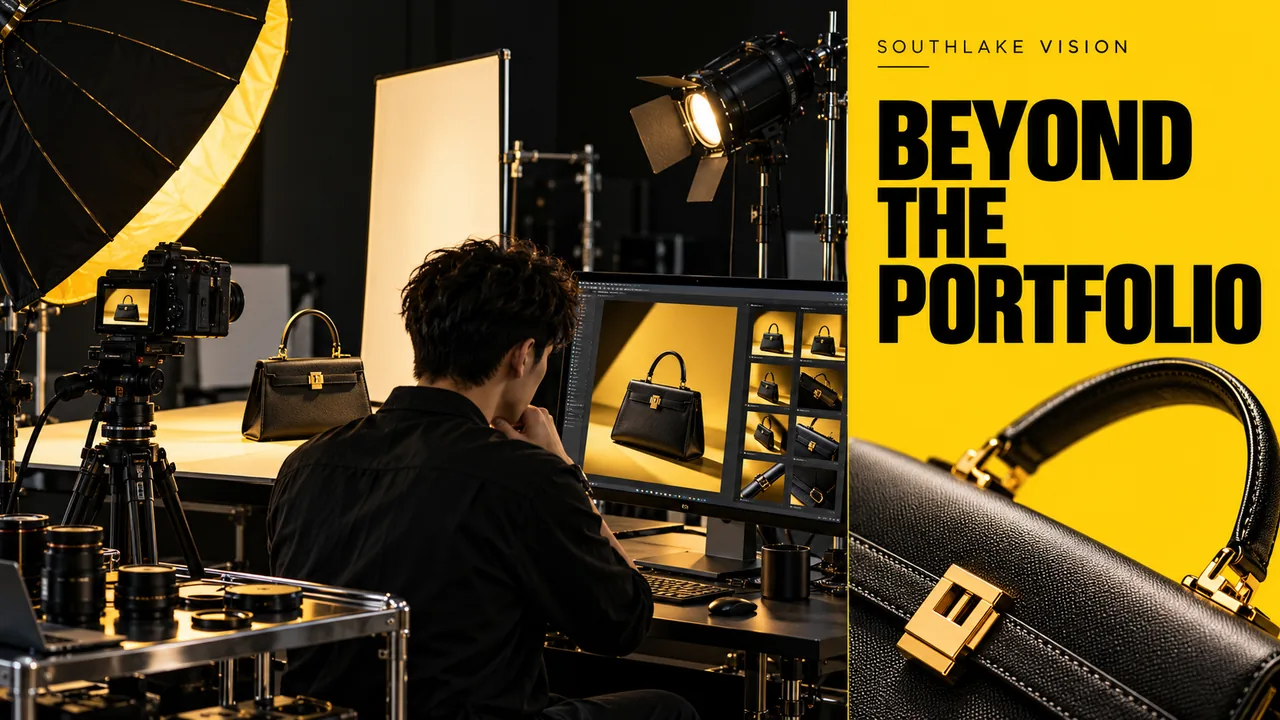
Original editorial cover illustration — Southlake Vision. Product imagery is illustrative.
Look for comparable production problems
Choosing a China product photography studio requires more than selecting the most dramatic portfolio picture. Ask whether the team has solved the same material, scale and information problems as your products. A carefully lit perfume bottle demonstrates different skills from an assembled chair, a textile collection or a transparent food container. Similar visual style does not automatically mean similar production requirements.
Build a comparison sheet around your difficult features. These might include reflective rims, pale embroidery, moving parts, curved labels or large assembly requirements. Request examples that show those features clearly, ideally across several angles rather than one hero frame. When reviewing Southlake Vision’s work, use the same standard: evaluate the problems represented in the images, then ask how the team would address the details of your own sample.
Ask what happened before the selected image
A finished portfolio image conceals the decisions that made it possible. Ask what information was available before shooting, how the sample was prepared and which references guided the composition. A studio that can explain those steps gives you evidence of a repeatable process. An image presented without context may be impressive but tells you little about how your project will be managed.
Useful questions are specific. How was the desired reflection defined? Who approved the styling? Were dimensions or product claims supplied by the client? Was the product photographed assembled or retouched from several captures? The purpose is not to demand confidential client material. It is to understand the division between physical preparation, photography, design and approvals, so expectations for your project are realistic.
Evaluate consistency across a series
Review sets of related products rather than isolated favourites. Look at camera height, product scale, shadow direction, colour treatment and cropping. A catalogue needs enough consistency that shoppers understand the range without being distracted by production differences. Deliberate variation can support a campaign, but accidental variation makes even good individual photographs feel disconnected.
For a hypothetical tableware collection, compare a plate, bowl and mug photographed in the same series. Do the whites belong together? Is the glaze credible? Are angles chosen intentionally for each shape? Ask which production records the team keeps for repeat orders. Reference images, positioning notes and approved retouching examples are practical evidence that a future batch can resemble the first without relying entirely on memory.
Separate capture ability from design ability
Some studios produce excellent source photographs but expect a separate agency to develop listing graphics. Others manage capture, copy layout and export together. Neither arrangement is inherently wrong, but you need to know which you are evaluating. A portfolio graphic may combine studio photography, client-supplied copy and external design, so ask who handled the relevant elements.
If you require Amazon image design, review typography, information hierarchy and the relationship between claims and pictures. Confirm how factual copy is approved. If you need only clean photography, ask whether masters provide enough crop flexibility for your designer. This distinction prevents a purchasing decision based on a finished asset that includes services absent from the actual proposal.
Use one representative test to resolve uncertainty
A small paid test can be useful when the assignment contains unusual materials or a large recurring volume. Choose a representative product with a real production challenge rather than the easiest item in the range. Define what the test should establish: reflection handling, brand treatment, approval communication or the suitability of delivered files for your downstream design workflow.
Set limits and acceptance criteria before the test begins. Agree which outputs are included and whether they can become part of the final project. Review both the result and the way questions were resolved. A test is less informative if the brief changes repeatedly or if several reviewers contradict one another. Treat it as a compact production exercise with a clear decision at the end.
Check the communication system, not just responsiveness
Fast replies are helpful, but reliable communication also requires organised decisions. Ask how feedback is consolidated, how files are named and how the current brief is identified. A team that answers quickly but loses version history can still produce avoidable mistakes. Remote production needs a record that survives handovers between photographers, retouchers and project contacts.
Describe a realistic exception and ask how it would be handled. What happens if a supplier sends the wrong colour, a component breaks, or approved copy arrives late? Look for a clear escalation path and written scope updates. The production process should show where the client makes decisions and where the studio takes responsibility, especially when multiple services are being coordinated.
Verify practical capacity for your assignment
Capacity is not only the number of photographers or the size of a building. It includes appropriate set space, preparation time, available people and the ability to keep parallel projects distinct. A large studio may still need advance planning for an oversized product or a particular model. Ask about the requirements of your assignment rather than requesting a general promise of unlimited flexibility.
Southlake Vision describes a production studio in Zibo and a marketing presence in Guangzhou, with photography and design teams supporting connected services. These facts provide context, but your proposal should still confirm location, preparation and schedule for the actual job. Review the studio background alongside the scope, and ask which dependencies could affect the first production date.
Inspect the handover before committing to repeat work
A reliable partner should explain what completion looks like. Ask for a sample delivery structure with sensitive information removed: folder hierarchy, naming conventions, export types and approval status. Determine whether you need editing files, photography masters or only final flattened exports. Confirm these requirements before comparing fees, since they influence future flexibility.
After an initial project, assess the handover as carefully as the hero image. Were all agreed items present? Could your team identify the approved version? Did a repeat crop preserve the product accurately? Record unresolved issues and use them to improve the next brief. A studio audit should lead to a practical working agreement, not merely a ranking of portfolios by visual impact.
Frequently asked questions
Should I choose a studio solely because it has photographed my exact category?
Category experience is useful, but examine the underlying production challenges too. A studio experienced with transparent glass and reflective metal may have relevant skills across several categories. Ask for comparable materials, scale and series consistency, then confirm your product-specific requirements.
Is a test shoot always necessary?
No. A clear portfolio, detailed scope and representative proof approval may provide enough confidence for a straightforward assignment. A test becomes more valuable when the material is unusual, the brand treatment is precise or the potential repeat programme is substantial.
Can I request another client’s original brief?
Avoid requesting confidential files. Ask instead for a general process explanation, an anonymised workflow example or a sample delivery structure. You need evidence of how decisions and handovers are managed, not access to another brand’s private commercial information.