
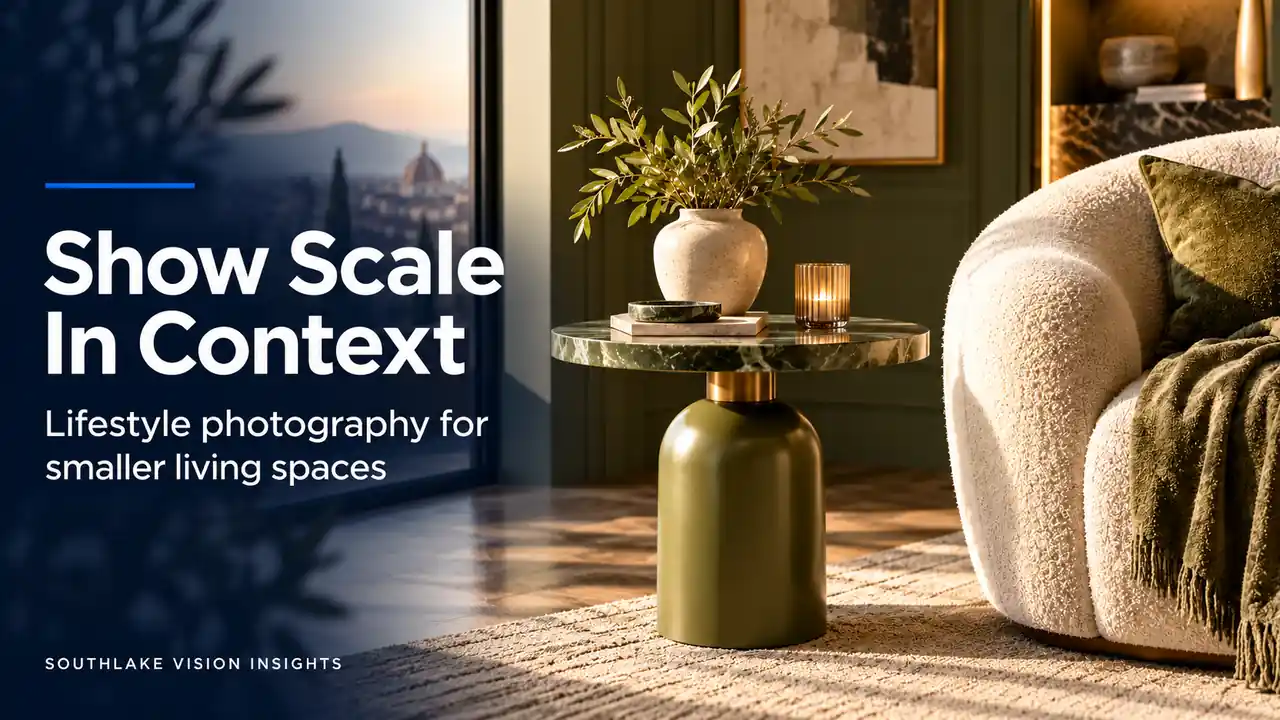
AI-generated editorial illustration. Not a Southlake Vision client project.
Show whether the product belongs in a real space
Small-space photography should answer a practical question: could this object work in a room like mine? An attractive interior alone cannot answer it. Buyers need understandable proportions, usable clearances and clues about everyday interaction. Wide-angle drama may make a compact room look spacious while making the product's size harder to judge.
At Southlake Vision, lifestyle imagery sits alongside clean product photography and commercial video. For a furniture brief, define the specific small-space situation before collecting decorative references. A bedside corner, rental dining area and narrow entrance have different constraints, and each suggests a different visual explanation of fit and use.
Build the scene from actual dimensions
Provide the product's overall dimensions and any operational footprint, including open drawers, pulled-out seats or extended supports. Sketch the intended room layout and mark the useful clearances. Styling decisions should respond to those measurements instead of creating a scene where everything barely fits outside the camera frame.
For a hypothetical compact desk, show whether a chair can tuck beneath it and whether the working surface accommodates the intended essentials. Do not substitute unusually small props to make the desk appear generous. A believable scene may reveal a genuine limitation, but that is more useful than a spacious-looking photograph that leaves customers disappointed after delivery.
Choose the camera position around proportion
Camera height and distance influence the perceived relationship between furniture and room. A very close wide view can enlarge the front edge while shrinking the rest of the object. Consider a more balanced camera position where the dimensions read naturally, then add a separate environmental frame if the room story needs more breadth.
Discuss these choices during lifestyle photography planning. Ask to review a setup frame before detailed styling begins. Check vertical lines and the relative size of familiar objects, rather than judging only the overall atmosphere. A slightly quieter composition may communicate scale much better than a dramatic angle that makes a narrow chair appear broad and substantial.
Use familiar context without implying inclusion
A common object can provide a useful scale cue, but it also affects the buyer's understanding of what is supplied. Keep accessories visually distinct and make the contents clear elsewhere in the image set. A decorative lamp on a console should not become the apparent subject when only the console is being sold.
Choose props with ordinary, credible dimensions. For a hypothetical side table, an unusually tiny book can exaggerate the surface area. An oversized arrangement can have the opposite effect. Review our furniture case category for environmental treatments, then select contextual objects that help explain your specific item rather than simply filling every available patch of space.
Photograph the useful action, not only the styled result
Small-space buyers often care about storage, access and movement. A closed cabinet looks tidy but does not explain whether the doors open comfortably in a narrow corner. Plan an action or alternate position that shows the relevant function, while keeping the room dimensions consistent between frames.
Consider whether stills or a short demonstration best communicate the movement. A folding chair might need stored, partly opened and ready-to-use views. A storage bed may need a clear lifting sequence. Avoid implying that a mechanism works effortlessly through awkward camera cuts that hide the actual interaction. The action should be understandable to someone seeing the product for the first time.
Let lighting reveal depth and material
Compact interiors can become visually flat when every surface is filled with equally bright light. Preserve enough tonal variation to show the furniture's edges and separation from the room. Dark objects need a readable outline; pale textiles need shape without losing their intended colour.
Keep the lighting logic credible across the scene. A chair near a window should not appear illuminated from an unrelated direction simply because the product was composited separately. If several captures are combined, check contact shadows and reflections carefully. The room may be styled, but the product should feel physically present, with understandable depth and a finish consistent with the approved sample.
Plan the mobile crop before final styling
A wide room image may become a narrow crop in a mobile storefront or advertisement. Identify what must survive that crop: complete product outline, opening mechanism, contact point or relevant scale cue. Leave practical space around the object, while avoiding an arrangement where the important furniture occupies only a tiny corner.
Capture alternate framing when one composition cannot serve every destination. Trying to extract a close vertical advertisement from a distant horizontal room view often loses both detail and context. Keep clean imagery and designed copy versions separate. This lets the team adapt a caption or layout without stretching the furniture or replacing the physical relationship that originally explained its size.
Approve the room as a buying explanation
Review the complete set against the initial small-space question. Does the customer understand the footprint, relevant movement and relationship to common furniture? Are the key dimensions available outside the image as well? A styled scene should complement accurate information, not ask the viewer to estimate everything from perspective.
To discuss a furniture lifestyle shoot, share product dimensions, target room situations and the operational features that need explanation. Southlake Vision can help connect the visual direction with a practical coverage plan. A convincing compact interior is not the room that appears largest; it is the scene that lets buyers understand how the product will work in a believable space.
Frequently asked questions
Should we use a very wide lens to show a small room?
A wider view can establish context, but extreme perspective may distort furniture proportions and apparent space. Choose the camera position around accurate product understanding, then add an environmental view if needed. A separate dimension image and action sequence can explain fit more reliably than one dramatic wide shot.
How can a furniture image explain clearance?
Show the relevant operational position, such as an open drawer or pulled-out chair, within a credible room arrangement. Provide verified dimensions separately and avoid hiding obstructions outside the crop. If the movement is difficult to understand in a still image, consider a short continuous demonstration from a clear angle.